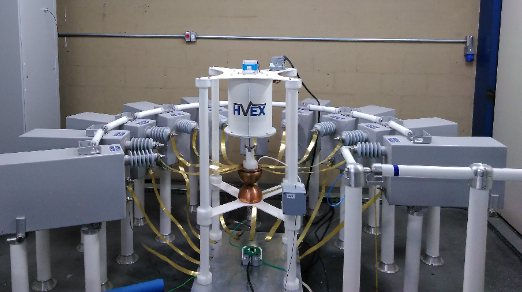

Impulse Current Generators
Surge currents from 1 kA to 350 kA for surge arrester and SPD testing
A metal-oxide surge arrester is bought on a residual voltage number and a discharge current rating, and both come out of an impulse current test. So does the qualification of a surge protective device, a lightning-protection connector or a grounding component. The generator that produces those currents has to hold the waveshape as faithfully at 350 kA as it does at 1 kA.
Output covers 1 kA to 350 kA, with residual voltage measured from 0.5 kV to 250 kV. The 8/20 µs waveshape is standard, with 4/10 µs, 10/350 µs and 10/700 µs available for lightning-protection and telecom surge work. Capacitance is 1 to 10 µF per unit, up to 200 µF across a full bank, so the stored energy is built to the duty. Acquisition is 12-bit at 2.5 GSa/s and the LIAS platform handles waveform evaluation and reporting.
Why it matters
350 kA covers the high-current impulse duty in IEC 60099-4 arrester type testing, not only the routine 8/20 µs shots.
The 10/350 µs waveshape is what lightning protection components are qualified against, and it comes from the same bank.
Residual voltage from 0.5 kV to 250 kV is captured in the same acquisition as the current, so the protective level comes from one record.
12-bit acquisition at 2.5 GSa/s captures the 8 µs front with enough points that the waveshape is measured rather than reconstructed.
Capacitance builds from 1 µF per unit to 200 µF total, so the bank is sized to the duty instead of bought at the maximum.
Ratings
Current: 1 kA to 350 kA
Residual voltage: 0.5–250 kV
Waveforms: 8/20 µs standard; 4/10 µs, 10/350 µs and 10/700 µs available
Capacitance: 1–10 µF per unit, up to 200 µF total
Data acquisition: 12-bit at 2.5 GSa/s
Software: LIAS impulse analysis platform
Standards
IEEE C62.11
IEC 60060-1
IEC 60099-4 (surge arresters)
IEC 62305-1 (lightning protection)
IEC 61643-11 (low-voltage SPDs)
ABNT NBR 6939 for South American projects
Applications
Metal-oxide surge arrester type and routine testing
Surge protective device qualification
Lightning-current withstand verification on hardware and connectors
Grounding and bonding component testing
Questions engineers ask
What is the difference between the 8/20 µs and 10/350 µs waveshapes?8/20 µs represents an induced surge and is the nominal discharge current waveshape for surge arresters and Type 2 surge protective devices. 10/350 µs represents a direct lightning strike and carries far more charge for the same peak, which is why it is used for Type 1 SPDs and lightning protection components under IEC 62305-1.
Can the generator measure arrester residual voltage?Yes. Residual voltage is measured from 0.5 kV to 250 kV alongside the current impulse, at 12-bit resolution and 2.5 GSa/s. That gives peak current and protective level from the same shot, which is what IEC 60099-4 and IEEE C62.11 type and routine test reports call for.
Technical documentation
Download HVEX Current Impulse Generator datasheet (English, PDF)
