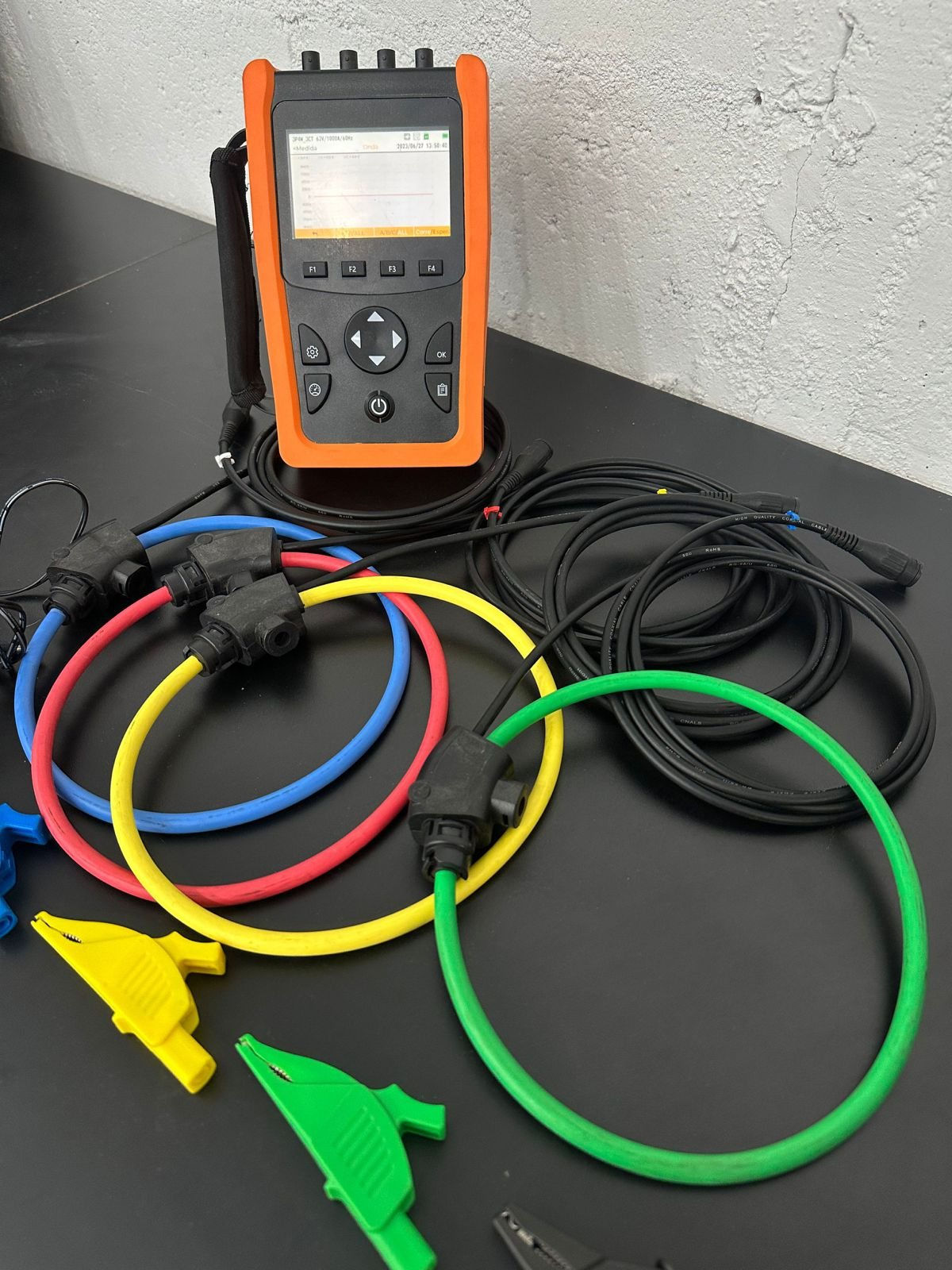

Portable Power Quality Analyzers
IEEE 519 surveys and sag capture from one CAT III instrument.
A power quality complaint is only worth what the record behind it proves. This analyzer captures voltage sags, swells, interruptions and flicker with the type, start time, duration, amplitude, half-cycle RMS value and the waveform, so the event that tripped the drive is documented rather than described. Harmonics are measured on voltage and current to the 50th order, which is the working range for an IEEE 519 assessment at the point of common coupling.
Inputs reach 690 V line-to-line with 1 kV AC isolation and CAT III 1000 V leads. Current comes from Rogowski coils or voltage-output clamps at 10 A, 600 A, 3,000 A and 6,000 A, so one kit covers a motor circuit and a main switchboard. Real-time waveform, harmonic spectrum with individual values and percentages, three-phase unbalance, demand, maxima and minima all read from the 3.97-inch 480 × 800 IPS display. The lithium battery runs six hours or more, extended models add 2,900 mAh with 16 GB of internal memory plus temperature and humidity, and data leaves as CSV over USB or through Modbus TCP/IP and Modbus RTU on networked models. The whole kit ships in an IP67 transport case.
Why it matters
Event records carry type, start time, duration, amplitude, half-cycle RMS and waveform, which is the evidence a utility or an OEM will accept when you escalate.
Harmonics to the 50th order on voltage and current cover an IEEE 519 compliance assessment without a second instrument.
Rogowski and clamp options from 10 A to 6,000 A mean the same case works on a lighting panel and on the main bus.
CAT III 1000 V leads and 1 kV AC isolation keep the instrument rated for the switchboard where these measurements actually get taken.
Six hours of battery plus an IP67 case covers a full shift of field work without a service outlet.
For permanent points the range extends to a DIN-rail analyzer, so a survey that finds a recurring problem can be converted into continuous monitoring without changing measurement method.
Ratings
Voltage: Up to 690 V line-to-line; 1 kV AC isolation
Current sensors: Rogowski coils and voltage-output clamps; ranges 10 A, 600 A, 3,000 A, 6,000 A
Harmonics: Voltage and current to the 50th order (51st-order THD on extended models)
Display: 3.97-inch IPS, 480 × 800
Battery: Lithium, ≥6 h continuous; extended models 2,900 mAh with 16 GB internal memory
Export: CSV; USB download; Modbus TCP/IP and Modbus RTU on networked models
Events: Voltage sag, swell, interruption and flicker capture with type, start time, duration, amplitude, half-cycle RMS and waveform
Category: CAT III 1000 V measurement leads
Case: IP67 transport case
Measured quantities: Real-time waveform display; voltage, current, power, energy, frequency, power factor; harmonic spectrum and individual harmonic values and percentages; three-phase unbalance; demand, maxima and minima; temperature and humidity on extended models
Extended range
Permanent DIN-rail analyzer: 16 GB micro-SD, Modbus TCP + RTU, powered from the measured circuit (90–528 VAC) or battery
Monitoring platform: Optional online power quality monitoring platform supporting large meter populations
Standards
IEEE 519
IEC 61000-4-30
IEC 61000-4-15 (flicker)
IEC 61000-4-7 (harmonics)
ANEEL PRODIST Module 8 for South American projects
Applications
Harmonic surveys and IEEE 519 compliance
Troubleshooting nuisance tripping and equipment damage
Capacitor bank and drive commissioning
Utility connection-point verification
Data center and hospital power audits
Questions engineers ask
Does this analyzer support an IEEE 519 harmonic study?Yes. It measures voltage and current harmonics to the 50th order, which covers the orders IEEE 519 evaluates at the point of common coupling, and it records demand so current distortion can be referenced to the demand current. Harmonic measurement follows IEC 61000-4-7 and the power quality methods follow IEC 61000-4-30.
What information is stored when a voltage sag occurs?Each event record holds the event type, start time, duration, amplitude, the half-cycle RMS trend and the captured waveform. That combination lets you separate a utility-side sag from a local motor start, and it is the level of detail a utility or an equipment manufacturer will ask for before accepting a claim.
Technical documentation
Download HVEX MPQ-100 Power Quality Analyzer datasheet (English, PDF)
